Roof Pitch Calculator
Use this free roof pitch calculator to turn a rise and run, an angle, or a pitch like 6:12 into every other roof measurement: pitch, angle in degrees, slope percent, roof area multiplier, and rafter length. Tap the i button next to any field for a plain-English explanation.
Quick answer: roof pitch = (rise ÷ run) × 12. A rise of 6 over a run of 12 is a 6:12 pitch, which is a 26.57° angle and a 50% slope.
Calculate your roof pitch
i
i
i
i
i
i
i
i
i
Estimates for planning only. Confirm measurements on site and follow your local building code and shingle manufacturer instructions. See our Disclaimer.
What is roof pitch?
Roof pitch tells you how steep a roof is. In the United States it is written as a ratio of vertical rise to 12 inches of horizontal run, so a 6:12 roof (also said “6 in 12”) rises 6 inches for every 12 inches it travels sideways. A low number means a gentle roof, and a high number means a steep one.
The reason people care is practical. Pitch decides which roofing materials you can use, how well water and snow shed, how a roof feels to walk on, and how much material you need to buy. So when someone asks what pitch is on a roof, the answer is that ratio, and the calculator above works it out for you.
How to calculate roof pitch
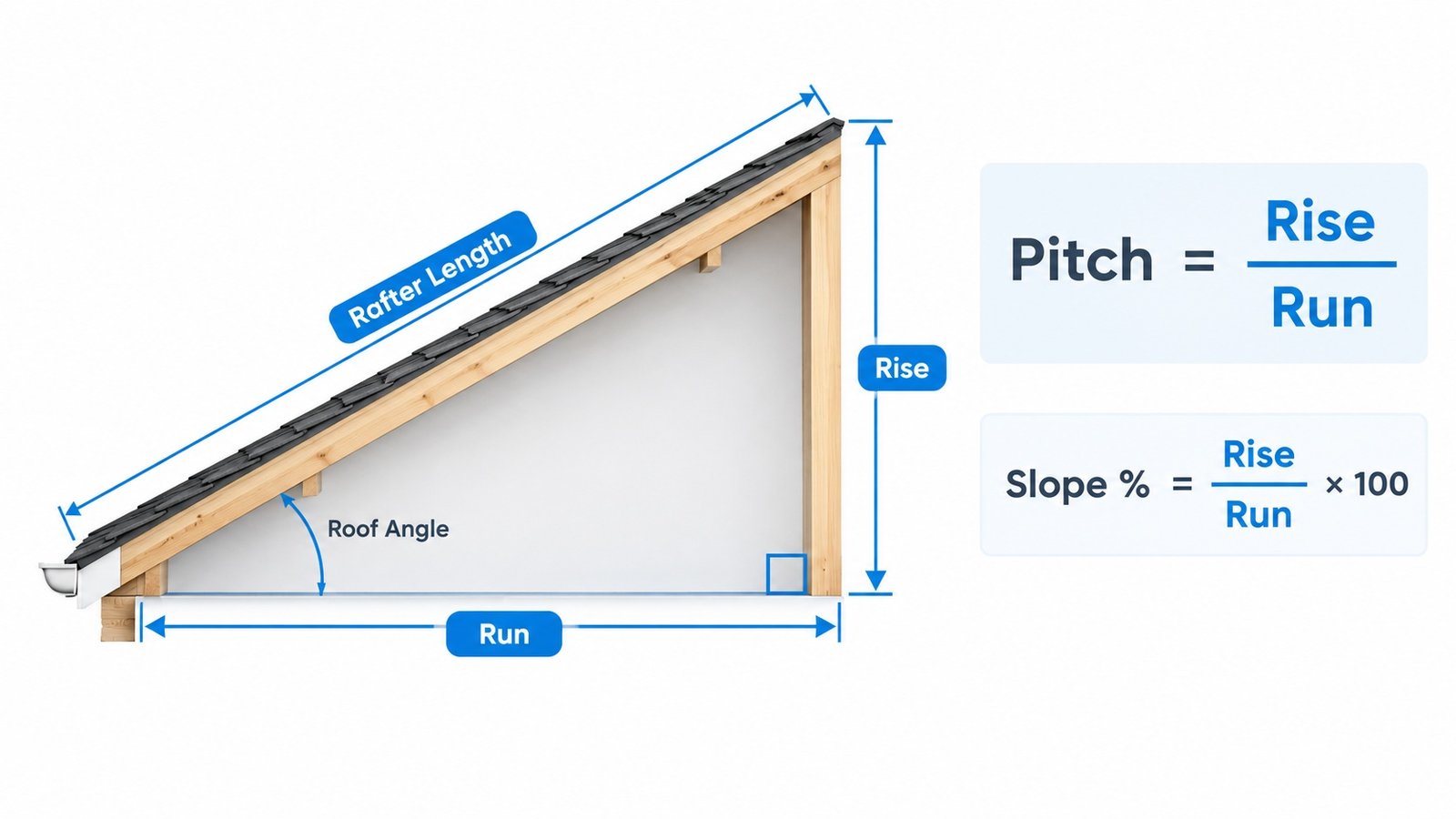
Calculating the pitch of a roof takes one division. Pitch is the rise divided by the run, scaled to a run of 12:
- Pitch (x:12) = (rise ÷ run) × 12
- Angle in degrees = arctan(rise ÷ run)
- Slope percent = (rise ÷ run) × 100
- Area multiplier = √(1 + (rise ÷ run)²)
These are standard right-triangle relationships. The roof is the long side of a triangle, the rise is the vertical side, and the run is the horizontal side, so the tangent of the roof angle equals rise divided by run.
Worked example
Say you measure a rise of 8 inches over a run of 16 inches. Rise ÷ run is 0.5. Multiply by 12 and the pitch is 6:12. The angle is arctan(0.5), which is 26.57 degrees. The slope is 50 percent, and the area multiplier is √1.25, or about 1.118. That means 1,000 square feet of flat footprint needs roughly 1,118 square feet of roofing before waste.
To calculate roof pitch in degrees from a pitch you already know, use the same idea: a 4:12 roof gives arctan(4 ÷ 12), so the angle of a 4/12 pitch is 18.43 degrees. The 6 in 12 roof pitch angle is 26.57 degrees, as shown above.
Roof pitch to degrees chart
Use this table when figuring roof angles from a pitch, or the other way round. It lists common pitches with their angle, slope percent, and area multiplier, all from the formulas above.
| Pitch | Angle | Slope | Area multiplier |
|---|---|---|---|
| 1:12 | 4.76° | 8.33% | 1.004 |
| 2:12 | 9.46° | 16.67% | 1.014 |
| 3:12 | 14.04° | 25.00% | 1.031 |
| 4:12 | 18.43° | 33.33% | 1.054 |
| 5:12 | 22.62° | 41.67% | 1.083 |
| 6:12 | 26.57° | 50.00% | 1.118 |
| 7:12 | 30.26° | 58.33% | 1.158 |
| 8:12 | 33.69° | 66.67% | 1.202 |
| 9:12 | 36.87° | 75.00% | 1.250 |
| 10:12 | 39.81° | 83.33% | 1.302 |
| 12:12 | 45.00° | 100.00% | 1.414 |
How to measure roof pitch
There are three practical ways to find the pitch of a roof. Pick the safest one for your situation, and never climb a wet or steep roof without proper fall protection.
1. From the attic
This is the safest method. Hold a level horizontally against a rafter, make a mark 12 inches along the level, then measure straight down or up from that mark to the rafter. That vertical distance is your rise in 12 inches, which is the pitch.
2. From the roof edge or a ladder
Place a level against the roof surface at the eave or gable end, mark 12 inches, and measure the vertical gap from the 12-inch mark to the roof. Only do this where you can reach safely from a stable ladder.
3. From the ground
Stand back from the gable end and hold a level at arm’s length. Hold a ruler or tape against the level, line it up with the slope, and read the number. It is the least accurate method, but good enough for a first estimate. A phone level app or a digital angle finder lets you read the angle directly, and you can enter it in the calculator.
On a 12-inch run, half an inch of error in the rise moves a 6:12 pitch to 6.5:12, so take each measurement twice and keep rise and run in the same unit.
Pitch, slope, angle, and gradient
People use several words for steepness, which causes confusion. Pitch usually means the x-in-12 ratio used in the US. Slope often means the same ratio, or the percent. Angle is measured in degrees. Roof gradient is common in the UK and Australia and is usually written as an angle in degrees or as a ratio like 1 in 4. A roof slope calculator and a roof pitch calculator are doing the same job in different units, which is why this tool shows all of them together.
Outside the US you will mostly see degrees. A 22.5 degree roof is close to 5:12, and a 30 degree roof is close to 7:12. Enter the angle directly using the second option in the calculator.
Roof pitch in degrees, gradients, and metric
Outside the US, roofs are usually described in degrees or as a gradient written “1 in X”, which means the roof rises 1 unit for every X units of run. Select Gradient (1 in X) or Roof angle in the calculator and it converts to the US pitch for you.
- 1 in 5: 11.31 degrees, about 2.4:12
- 1 in 4: 14.04 degrees, 3:12
- 1 in 3: 18.43 degrees, 4:12
- 1 in 2: 26.57 degrees, 6:12
- 1 in 1: 45 degrees, 12:12
The calculator also shows the rise per metre in millimetres. A 6:12 roof is a slope of 0.5, so it rises 500 mm for every metre of run. Choose mm, cm, or m as the length unit and the rafter length comes out in the same unit.
Low, conventional, and steep pitch
There is no single legal definition, but builders often group roofs like this:
- Low slope: under about 4:12. Water drains slowly, so material choice and underlayment matter most.
- Conventional: about 4:12 to 9:12. This is the most common range for houses and works with most materials.
- Steep: above about 9:12. It sheds water and snow well, but it is harder and costlier to work on.
The labels in the calculator follow these ranges as general guidance. Your material’s installation instructions are what actually decide what is allowed.
Why roof pitch matters
Materials. Every roofing product has a minimum slope. The International Residential Code allows asphalt shingles only on slopes of 2:12 or steeper, and requires double underlayment from 2:12 up to 4:12. Local codes and manufacturers can be stricter, so check yours. Metal and membrane roofing can handle lower pitches.
Water and snow. Steeper roofs shed water and snow faster. Low-slope roofs hold water longer, which raises the risk of leaks at seams and flashing.
Cost and safety. Steeper roofs have more surface area, need more material, and often need extra safety equipment for installers, which raises labor costs.
Roof area and rafter length
Once you know the pitch, the area multiplier turns your flat footprint into real roof surface. Multiply the footprint area by the multiplier: a 4:12 roof is about 5 percent larger than its footprint, and a 12:12 roof is about 41 percent larger. Add waste for cuts, valleys, and hips on top of that.
The rafter length shown by the calculator uses your building width and overhang. It takes half the width, adds the overhang, and multiplies by the area multiplier. It does not include the ridge board, birdsmouth cuts, or fascia allowances, so add those to your framing plan. For shed roofs, use the full run from the high wall to the low wall instead of half the width. For a full rafter layout with cut angles and board size, use our rafter calculator.
Common mistakes to avoid
- Measuring the run along the roof. Run is always horizontal. Measuring along the sloped surface makes the run too long and the pitch too low.
- Using the full width as the run. On a gable roof each side rises over half the building width, so a 24-foot-wide house has a 12-foot run.
- Ordering from the footprint. A 6:12 roof has about 12 percent more surface than the floor area below it, before waste, overhang, and valleys.
- Mixing units. Rise in inches and run in feet gives a wrong ratio. Convert first.
Frequently asked questions
How do I calculate roof pitch?
Divide the rise by the run and multiply by 12. For example, a rise of 6 over a run of 12 is a 6:12 pitch.
How do I calculate roof pitch in degrees?
Take the arctangent of rise divided by run. A 6:12 roof gives about 26.57 degrees.
What is the angle of a 4/12 pitch?
A 4:12 pitch is about 18.43 degrees, with a slope of 33.33 percent.
What is the 6 in 12 roof pitch angle?
A 6 in 12 roof is about 26.57 degrees, with a slope of 50 percent.
What is the minimum pitch for shingles?
Under the International Residential Code, asphalt shingles can be used only on roofs of 2:12 or steeper, and slopes from 2:12 up to 4:12 need double underlayment. Check your local code and the shingle manufacturer’s instructions.
Can I find the pitch of a roof from the ground?
You can estimate it with a level and a ruler, or a phone level app. For an accurate result, measure from the attic or use an angle finder.
How this calculator works
Whatever you enter, the calculator first converts it to one number: the slope, which is rise divided by run. From a rise and run it divides directly. From an angle it takes the tangent. From a pitch it divides by 12. Every result is then derived from that slope using the formulas above and rounded to two decimals. Invalid entries, such as a run of zero or an angle of 90 degrees or more, are rejected with a message instead of producing a wrong answer.
Example: a 24-foot-wide garage
Take a gable garage 24 feet wide and 30 feet long, with a 6:12 roof and a 1-foot overhang. Half the width is 12 feet, plus the 1-foot overhang makes 13 feet of horizontal run. Multiply by the 1.118 area multiplier and each rafter is about 14.53 feet along the slope. The 720 square foot footprint becomes roughly 805 square feet of roof surface, before the overhang, waste, and ridge cap. Enter 6 as the pitch, 24 as the width, and 1 as the overhang to check these numbers yourself.
The formulas are standard right-triangle trigonometry. Material limits depend on the product, so follow your shingle manufacturer’s installation instructions and your local building code.
Sources and further reading
The slope, angle, gradient, and area multiplier come from right-triangle trigonometry. The shingle slope limits mentioned above are from the International Residential Code, section R905.2.2, as summarized by these pages:
- Goodhue County, Minnesota: Residential roofing code highlights (PDF)
- City of Hopkins, Minnesota: Asphalt shingles (R905.2)
- Roof Observations: Minimum roof pitch for asphalt shingles (quotes the 2024 IRC)
Codes are adopted locally and change over time, so confirm the rules with your local building department.
Related calculators: Use the roof calculator, work out rafter length with the rafter calculator, or estimate the budget with the roof replacement cost calculator.