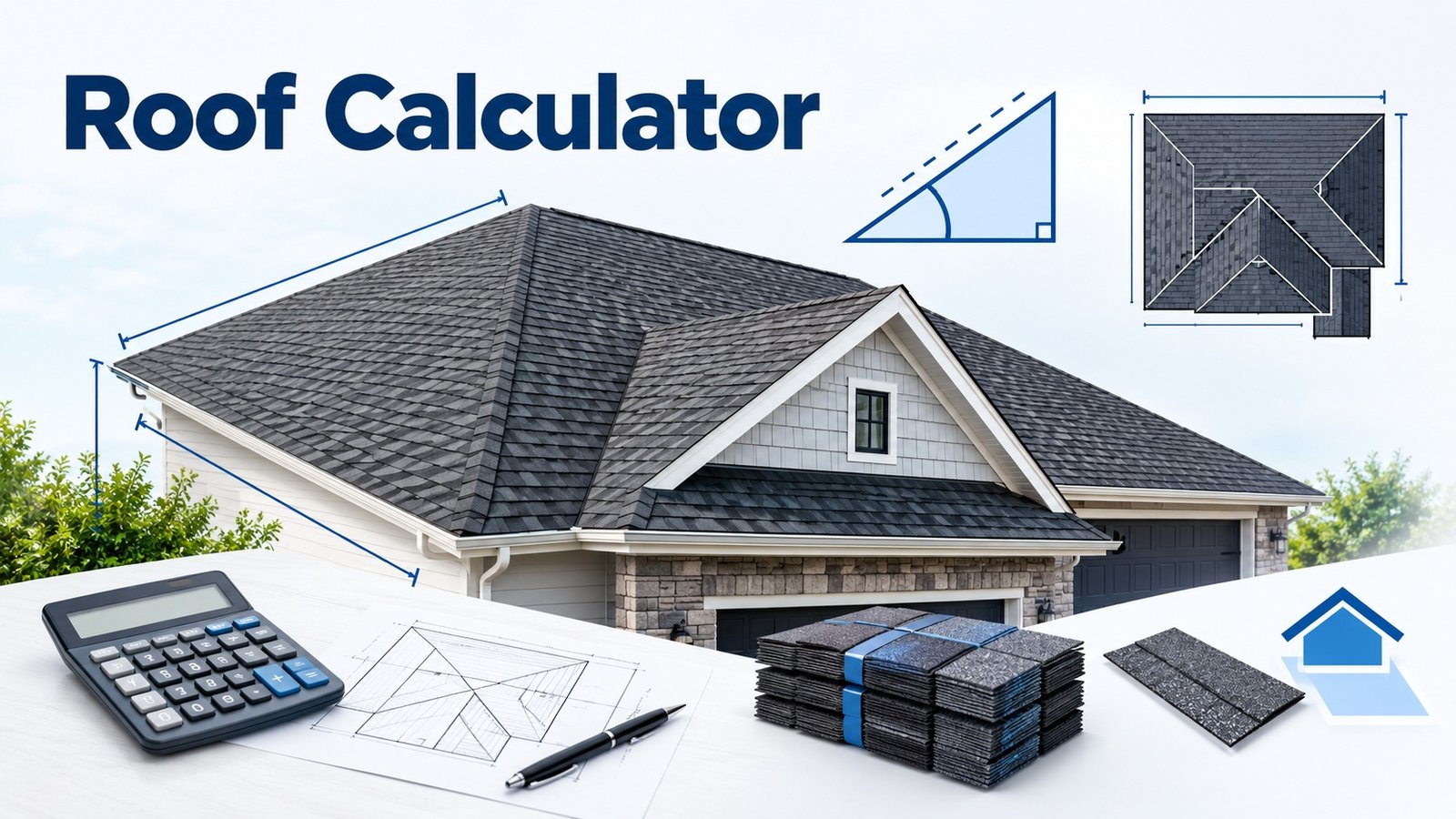
Roof Calculator
Use this free roof calculator to find your roof surface area, roofing squares, and shingle bundles from the size of your building, the roof pitch, and a waste allowance. Tap the i button beside any field for a plain-English explanation.
Quick answer: roof area = building length × width × √(1 + (pitch ÷ 12)²). A 40 × 30 foot building at 6:12 has 1,200 × 1.118 = about 1,342 square feet of roof, which is 13.4 roofing squares before waste.
Calculate your roof area and shingles
i
i
i
i
i
i
i
i
i
i
i
From footprint to order quantity
Roof area at other pitches (same footprint)
Estimates for planning only. Confirm quantities with your supplier or installer before ordering. See our Disclaimer.
What this roof calculator does
Ordering roofing material starts with one number: how big your roof really is. The trouble is that a roof is always larger than the floor plan under it. A 1,200 square foot footprint can carry well over 1,300 square feet of roof once the slope is counted, and that gap decides how many bundles of shingles you buy.
This roof calculator closes that gap. Enter the length and width of the building, or an area you already know, along with the pitch and a waste allowance. It returns the roof surface area, the number of roofing squares, the bundles of shingles to order, and a rough material cost if you add a price. Two graphics help you check the result: a bar breakdown from footprint to order quantity, and a chart showing how the same footprint grows as the pitch gets steeper.
It pairs with the other tools on this site. If you do not know your pitch, find it with the roof pitch calculator. To cut the framing, use the rafter calculator. To turn your squares into a budget, try the roof replacement cost calculator.
How to calculate roof square footage
People often ask how to calculate roof square footage or roof area from the ground. The method is short, and it works for any roof where every plane has the same pitch:
- Footprint area = length × width (add the overhang to each side if you want to cover it)
- Pitch multiplier = √(1 + (pitch ÷ 12)²)
- Roof surface area = footprint area × pitch multiplier
- Area to order = roof surface area × (1 + waste percentage)
The multiplier comes from the same right triangle used on our pitch and rafter pages: the roof surface is the long side, and the flat distance it covers is the base. A 6:12 roof has a multiplier of 1.118, so every 100 square feet of footprint becomes about 112 square feet of roof.
One useful detail: the multiplier applies to the whole footprint even when the roof has hips and valleys, as long as every plane has the same pitch. You do not need to measure each slope separately in that case. Different pitches on different parts of the house need their own calculation, which the section on complex roofs covers.
Roofing squares and bundles
Roofers do not price in square feet. They use the roofing square, which is 100 square feet of roof surface. Divide your roof area by 100 and you have the number of squares. A 1,650 square foot roof is 16.5 squares.
Shingles are sold in bundles, and the number of bundles in a square depends on the product. Manufacturer guidance, such as GAF’s guide to measuring a roofing square, notes that three bundles make a square for many asphalt shingles, while some designer styles need more. The calculator lets you choose 3, 4, or 5 bundles per square. Always check the packaging or the product data sheet for your shingle, because that number is the one that matters when you place the order.
With three bundles per square, one bundle covers about 33 square feet. With four, it covers 25. Using the wrong figure is one of the easiest ways to end up with a pallet too many or, worse, one too few.
Pitch multiplier table
Use this table for a quick estimate. It shows the roof surface area for a 1,000 square foot footprint at common pitches, using the multiplier above.
| Pitch | Multiplier | Roof area per 1,000 sq ft of footprint |
|---|---|---|
| 3:12 | 1.031 | 1,031 sq ft |
| 4:12 | 1.054 | 1,054 sq ft |
| 5:12 | 1.083 | 1,083 sq ft |
| 6:12 | 1.118 | 1,118 sq ft |
| 7:12 | 1.158 | 1,158 sq ft |
| 8:12 | 1.202 | 1,202 sq ft |
| 9:12 | 1.250 | 1,250 sq ft |
| 10:12 | 1.302 | 1,302 sq ft |
| 12:12 | 1.414 | 1,414 sq ft |
The jump from 4:12 to 12:12 adds about 34 percent more roof for the same house. That is why the pitch matters so much for material and labor, and why the chart under the calculator is worth a look before you commit to a steep design. If you only know the angle, the roof pitch calculator converts degrees to a pitch you can enter here.
How much waste to add
Shingles are cut at edges, hips, valleys, and around penetrations, and a few are damaged on the job. That is why you order more than the measured area. A common rule of thumb is about 10 percent for a simple gable roof, about 15 percent for a hip roof, and 20 percent or more for a roof with many valleys, dormers, or angles. These are planning figures rather than rules, so ask your supplier or installer what they recommend for your roof and your shingle.
Keep the waste figure separate from the base area. The calculator shows the squares without waste and the squares to order, so you can see exactly how much the allowance adds and discuss it with your contractor.
Measuring complex roofs
Few houses are a single rectangle. For an L-shaped or cut-up roof, break the footprint into simple shapes and add them up:
- Sketch the building outline from above and split it into rectangles.
- Measure each rectangle and calculate its area. Add the overhang if you want it included.
- Add the areas into one footprint total and enter it with the Footprint area option.
- If sections have different pitches, calculate each section on its own and add the roof areas together.
Dormers, skylights, and chimneys need judgment. Many installers do not deduct small openings because of the extra cutting around them, but practice varies, so ask yours. If you already measured the sloped surface directly, choose the Roof surface area option and the calculator skips the multiplier.
Measure from the ground or from plans whenever you can. If you must climb, use proper fall protection and never work on a wet or steep roof alone.
Two worked examples
Example 1: a simple gable house
The building is 40 feet long and 30 feet wide, with a 6:12 roof and a 1-foot overhang on every side. With overhang the footprint is 42 × 32 = 1,344 square feet. Multiply by 1.118 to get 1,502.6 square feet of roof. Add 10 percent waste for 1,652.9 square feet, which is 16.53 squares. At 3 bundles per square, that is 49.6 bundles, so order 50. Without the overhang, the same house is 1,200 square feet of footprint, 1,341.6 square feet of roof, and 45 bundles with the same waste.
Example 2: an L-shaped house
The main block is 40 × 24 feet and the wing is 20 × 16 feet, so the footprint is 960 + 320 = 1,280 square feet. The roof is 7:12 throughout, with a multiplier of 1.158. The roof surface is about 1,481.9 square feet. Add 15 percent for the extra hips and valleys to get 1,704.1 square feet, or 17.04 squares. At 3 bundles per square, that is 51.1 bundles, so order 52. Enter these figures to confirm each step.
From squares to cost
Squares are also how most roofing quotes are written, so once you know yours you can compare bids on equal terms. This calculator has an optional price-per-square field that multiplies your squares to order by the price you enter, which is useful for checking a material quote. It does not include labor, tear-off, underlayment, flashing, or disposal, and prices vary by region, material, and season, so I do not put a built-in price in it. For a fuller budget, use the roof replacement cost calculator.
Common mistakes to avoid
- Using floor area as roof area. A house’s living area is not its roof size. Roofs are bigger because of slope and overhang.
- Forgetting the overhang. One foot all round on a 40 × 30 house adds 144 square feet of footprint before the multiplier.
- Using the wrong bundles per square. Check the shingle’s data sheet rather than assuming three.
- Skipping waste. Ordering exactly the measured area almost always leaves you short.
- Mixing units. Entering metres and reading the answer as feet changes the result by a factor of about ten. Pick the unit first.
- Treating different pitches as one. A shallow porch roof and a steep main roof need separate multipliers.
How this calculator works and what it assumes
The calculator runs in plain JavaScript in your browser, so your measurements are not sent anywhere. It finds the footprint area, multiplies by the pitch multiplier, adds waste, converts to squares using 100 square feet per square, and rounds the bundle count up to a whole bundle. Metric inputs are converted at 10.764 square feet per square metre.
What it assumes, and what it leaves out:
- Every roof plane has the same pitch, unless you use the measured-surface option.
- Overhang is the same on all four sides.
- Bundles per square is the figure you choose, not a lookup for a specific product.
- No deduction for chimneys, skylights, or dormers, and no allowance for ridge cap, starter strip, underlayment, or flashing. Use a shingle-specific calculator for those.
I am a software engineer, not a roofer or engineer, so use the result as a planning figure and confirm quantities with your supplier or installer before you order. Change log: October 6, 2026, first published with area, squares, bundles, waste, cost, and charts.
Frequently asked questions
How do I calculate roof square footage?
Multiply the building length by its width to get the footprint, then multiply by the pitch multiplier. A 40 by 30 foot footprint at 6:12 is 1,200 × 1.118, or about 1,342 square feet.
How many roofing squares are in 1,500 square feet?
One roofing square is 100 square feet, so 1,500 square feet is 15 squares. Add waste on top of that before you order.
How many bundles of shingles do I need?
Multiply the squares to order by the bundles per square, then round up. Many asphalt shingles use 3 bundles per square, so 16.5 squares needs 50 bundles. Check your shingle’s data sheet.
What is a roofing square?
A roofing square is 100 square feet of roof surface. It is the unit roofers use to measure and price a job.
How much waste should I add?
About 10 percent is a common starting point for a simple gable roof, and 15 to 20 percent for hips, valleys, and dormers. Ask your supplier for the right figure for your roof.
Does the multiplier work with hips and valleys?
Yes, if all planes share the same pitch, the roof area equals the footprint times the multiplier. Waste is higher on those roofs because of extra cuts.
How do I convert square metres to roofing squares?
Multiply the area in square metres by 10.764 to get square feet, then divide by 100. For example, 150 square metres is about 16.1 squares.
Is the roof area the same as the floor area?
No. The roof is larger because of the slope and the overhang, so use the pitch multiplier rather than your floor area.
Related calculators: find your pitch with the roof pitch calculator, size the framing with the rafter calculator, or budget the job with the roof replacement cost calculator.
Sources and further reading
The area, multiplier, and squares math is basic geometry. The definition of a roofing square and the bundles-per-square guidance are covered by GAF: How to Measure a Roofing Square and Roofr: What Is a Roofing Square?. Waste percentages are common rules of thumb, so confirm them with your supplier.