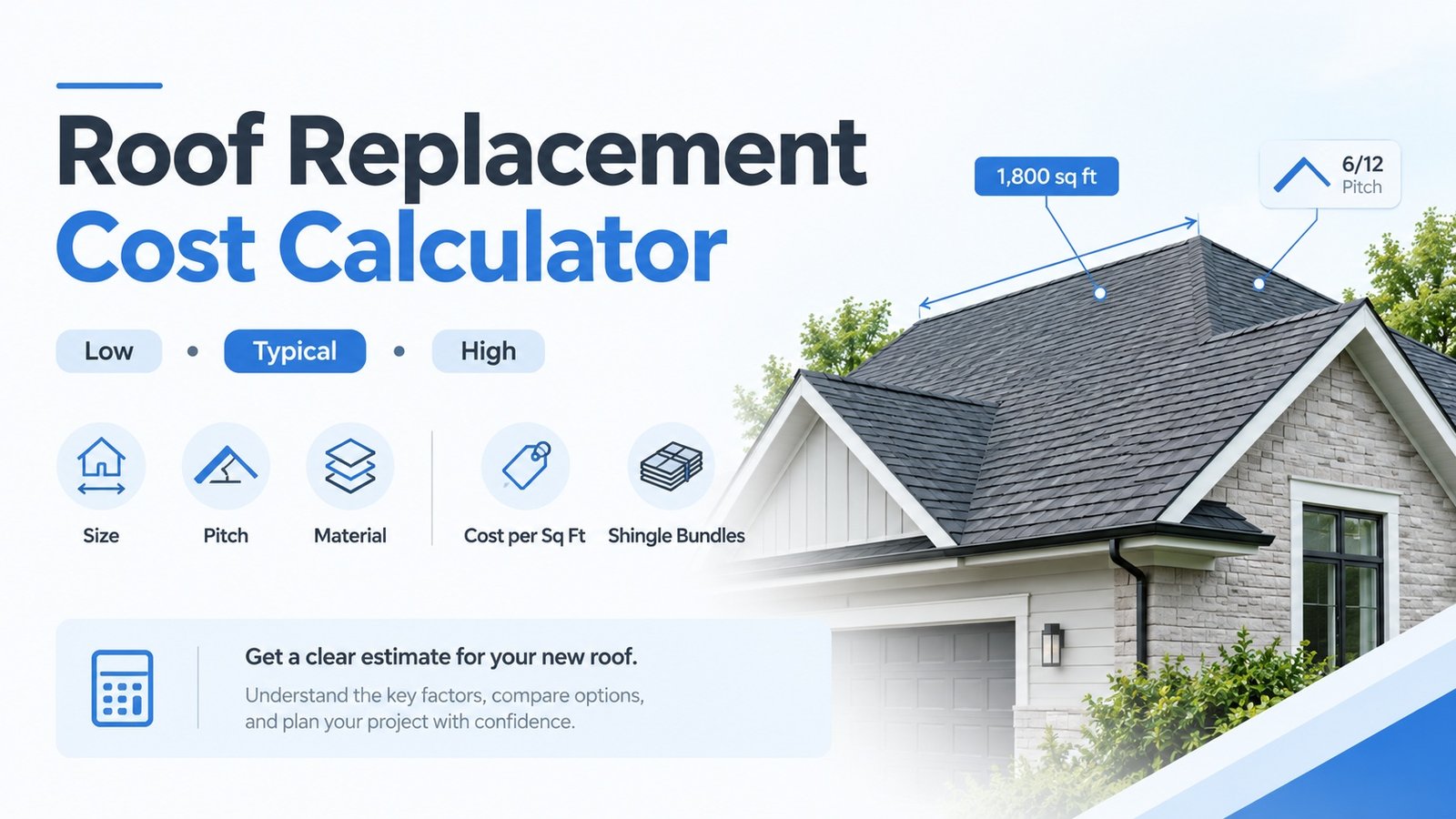
Roof Replacement Cost Calculator
Wondering how much a new roof will cost? This free roof replacement cost calculator turns your roof size, pitch, material and extras into a low, typical and high estimate, a cost per square foot, the roofing squares and shingle bundles to order, and a price comparison across every material. Tap the i button beside any field for a plain-English explanation. Part of our roofing calculators.
Quick answer: most homeowners pay about $8,000 to $20,000 to replace an asphalt shingle roof, or roughly $4 to $7 per square foot installed. Metal, tile and slate cost more, and tear-off, decking repairs and flashing add to the total.
Estimate your roof replacement cost
i
i
i
i
i
i
i
i
i
i
i
i
i
i
i
i
i
i
i
Where the money goes (typical)
Typical cost by material (same inputs)
Planning estimate based on national average 2026 pricing. It is not a quote. Local labor, material prices and hidden damage change real bids, so get at least three written quotes from licensed roofers. See our Disclaimer.
How the roof replacement cost calculator works
The calculator starts with the size of your roof. If you only know the footprint of the house, choose that option and set the pitch. The tool multiplies the footprint by a pitch factor, because a sloped roof has more surface than the floor plan below it. A 6/12 roof, for instance, is about 12% larger than its footprint. If you want the area and shingle bundles worked out in more detail, the roof calculator does that.
Next it applies an installed price range for your chosen material. That range covers shingles or panels, standard labor, nails and basic flashing. On top of it go the line items that surprise people at quote time: tearing off old layers, replacing damaged decking, a better underlayment, flashing around chimneys and skylights, vents, gutters and permits. Complexity, height and your local price level then scale the result.
You get three numbers. The low figure assumes competitive bids and easy access. The high figure assumes premium labor and tougher conditions. The typical figure sits between them and is the best starting point for a budget.
How much does a new roof cost?
For most American homes, a full asphalt shingle replacement lands between roughly $8,000 and $20,000. A modest 1,500 square foot roof can come in under that range, while a large two-story house with a cut-up roofline can pass it. Metal, slate and tile push totals into the $20,000 to $60,000 territory because both the material and the skill needed to install it cost more.
People asking how much a new roof costs often want a single number, and that is where estimates go wrong. Two houses with the same square footage can differ by $10,000 because of pitch, number of layers, local labor rates and how much of the wood underneath has rotted. Treat any national average as a starting line, then use the calculator to see where your own house falls. If you are asking how much a new roof costs for a house you plan to sell soon, architectural shingles usually give the best return.
Rule of thumb: multiply your roof surface area by $4 to $7 for architectural asphalt shingles, then add roughly 25% to 40% for tear-off, decking repairs, underlayment and extras.
How much does a roof cost per square foot?
Roofers price by the “square”, which is 100 square feet of roof. Quotes are easier to compare once you convert them. The ranges below are the installed prices the calculator uses before extras and multipliers.
| Material | Per sq ft installed | Per square (100 sq ft) | Typical lifespan |
|---|---|---|---|
| 3-tab asphalt shingles | $3.20 – $5.00 | $320 – $500 | 15–20 years |
| Architectural shingles | $4.00 – $7.00 | $400 – $700 | 25–30 years |
| Metal, exposed-fastener | $6 – $10 | $600 – $1,000 | 30–45 years |
| Metal, standing seam | $10 – $17 | $1,000 – $1,700 | 40–70 years |
| Wood shakes | $9 – $16 | $900 – $1,600 | 25–35 years |
| Clay or concrete tile | $11 – $21 | $1,100 – $2,100 | 50+ years |
| Natural slate | $16 – $32 | $1,600 – $3,200 | 75–100 years |
| TPO, EPDM, modified bitumen (flat) | $4 – $9 | $400 – $900 | 15–30 years |
If you plan to stay twenty years or more, a longer-lived metal roof can cost less over its lifetime even though the upfront price is higher. A 3-tab roof that fails in 15 years often costs more than architectural shingles that last 30.
Roof replacement cost by roof size
Size is the first thing every roofer asks about, so here is what the calculator returns for architectural shingles on a simple roof at about a 6/12 pitch. The scope is a typical one: one layer torn off, about 10% of the decking replaced, synthetic underlayment, one chimney re-flashed, four vents, a permit and average US pricing. Change any setting above and the numbers move.
| Roof area | Typical total | Low to high | Roofing squares |
|---|---|---|---|
| 1,000 sq ft | $9,180 | $6,380 – $11,970 | 10 |
| 1,500 sq ft | $13,150 | $9,250 – $17,060 | 15 |
| 2,000 sq ft | $17,130 | $12,110 – $22,150 | 20 |
| 2,500 sq ft | $21,110 | $14,980 – $27,240 | 25 |
| 3,000 sq ft | $25,090 | $17,840 – $32,330 | 30 |
How these numbers compare with published 2026 data
This Old House reports an average of about $15,400 for a 2,000 square foot asphalt shingle roof in its 2026 homeowner survey, with a wide range from roughly $6,900 to $24,000 (source). InchCalculator puts most replacements between $6,700 and $25,000, with about $14,000 for a 2,000 square foot roof (source). Our typical figure for the same roof is a little higher because it includes items some averages leave out, such as the permit, chimney flashing and a synthetic underlayment. If you want a leaner number, set the permit to exclude, remove the chimney and choose standard felt.
What changes the cost to replace a roof
Roof size and shape
Size is the biggest driver, but shape matters almost as much. Every valley, hip, dormer and wall junction adds cutting time, flashing and waste. That is why the calculator has a complexity setting and a waste setting.
Pitch and height
Steep roofs are slower and riskier to work on. Crews need harnesses, roof jacks and extra time, so pitches above 7/12 carry a surcharge. A three-story house adds a similar premium for hauling material and debris.
Tear-off and disposal
Removing one layer of old shingles typically costs $0.80 to $1.50 per square foot including disposal. A second layer adds roughly the same again. Some areas allow a new layer over the old one, but most roofers advise against it because it hides rot and shortens the new roof’s life.
Decking repairs
You will not know how much plywood or OSB is damaged until the old roofing comes off. Budgeting for 10% replacement is sensible. Ask your contractor for a per-sheet price in writing so a surprise does not turn into a negotiation.
Underlayment, flashing and ventilation
Synthetic underlayment tears less and handles weather better than felt. In cold climates, ice and water shield along the eaves and valleys protects against ice dams. Reflashing chimneys and skylights is not optional, because old flashing is a leading cause of leaks. Good attic ventilation also extends shingle life, a point the U.S. Department of Energy’s Energy Saver guide covers well.
Where you live
Labor and permit costs vary widely. A roof that costs $11,000 in a lower-cost region may cost $15,000 or more in a coastal metro. Wind, hail and wildfire zones can also require upgraded materials. Homeowners in storm-prone areas may want to look at the FORTIFIED Roof standard from the Insurance Institute for Business and Home Safety, which some insurers reward with discounts.
How to calculate roof pitch and figure roof angles
Pitch is the slope of your roof, written as rise over run. A 6/12 roof rises 6 inches for every 12 inches it extends horizontally. To calculate roof pitch you only need a level, a tape measure and a few minutes.
- Hold a level horizontally against the underside of a rafter in the attic and mark 12 inches along it.
- Measure straight up from the 12-inch mark to the rafter.
- That vertical distance in inches is the rise. A reading of 6 means a 6/12 pitch.
For the angle, take the arctangent of rise divided by run. This is the method behind figuring roof angles, and a 6/12 roof works out to about 26.6 degrees. You can also work out the pitch of a roof from the ground with a smartphone level app, though the attic method is more accurate. For a dedicated tool, use our roof pitch calculator, and once you know the pitch, the rafter calculator gives rafter lengths and cut angles.
Quick pitch tool
| Pitch | Angle | Surface factor | Feel |
|---|---|---|---|
| 4/12 | 18.4° | 1.054 | Low, walkable |
| 6/12 | 26.6° | 1.118 | Common, walkable |
| 8/12 | 33.7° | 1.202 | Steep, needs safety gear |
| 10/12 | 39.8° | 1.302 | Very steep |
| 12/12 | 45.0° | 1.414 | Extreme |
Pitch also tells you which materials are allowed. Standard shingles generally need at least 4/12, while anything flatter calls for a low-slope membrane.
Flat roof replacement cost
If you want a flat roof replacement cost calculator, select TPO, EPDM or modified bitumen in the material list. The tool ignores pitch for these systems, since low-slope roofs have almost no extra surface area. Prices run $4 to $9 per square foot, depending on membrane thickness, insulation and how the seams are joined.
Flat roofs fail differently than sloped ones. Standing water, poor drainage and cracked seams are the usual culprits, so a good bid includes tapered insulation or drain fixes where needed. Ask about membrane thickness (60 mil is a common upgrade) and the length of the workmanship warranty.
Commercial roof replacement cost
For a commercial roof replacement cost estimate, choose “Commercial / multi-unit” and a flat membrane. The calculator adds a 15% premium for crane or hoist access, safety planning, permits and working around tenants. Large, open roofs are efficient to install, so the per-square-foot price often falls as the area grows, yet total projects still run from tens of thousands to several hundred thousand dollars.
Commercial work also involves insulation requirements, drainage design and manufacturer warranties that can run 20 years. Bring in a roofing consultant or the manufacturer’s rep for large buildings. The National Roofing Contractors Association publishes technical guidance and lets you find member contractors.
How much to replace a roof: ways to save without cutting corners
- Get three written bids. Compare scope line by line: tear-off, underlayment, flashing, ventilation and cleanup.
- Schedule off-season. Late fall and winter in mild climates often bring better pricing than peak summer.
- Choose the right material, not the cheapest. The lowest price per square foot is rarely the lowest cost per year of life.
- Bundle repairs. If you need new gutters or a chimney repair, doing it with the roof saves mobilization time.
- Ask about warranties. Some shingle makers offer enhanced warranties when certified installers use a full system.
- Check your insurance. Storm and hail damage may be covered. Wear and age usually are not.
Be cautious of door-to-door storm chasers, large upfront deposits and quotes with no licence or insurance details. Ask for proof of liability and workers’ compensation coverage before signing anything.
Replace or repair?
A repair makes sense when damage is limited to a small area and the rest of the roof has years left. Replace when shingles are curling or losing granules widely, when leaks keep returning, or when the roof is near the end of its rated life. If repairs would cost more than about a third of a replacement, replacing is usually the better value.
How to read a roofing quote
A calculator gives you a range. The quote tells you what you are actually buying. Before you sign, check that each of these is written down:
- Tear-off. How many layers come off, and who pays for disposal.
- Decking. A price per sheet for any rotten plywood or OSB, so a surprise has a known cost.
- Underlayment and flashing. The exact products, including drip edge, valley flashing and chimney flashing.
- Shingle line and warranty. The manufacturer, product name and warranty type, plus the contractor’s own workmanship warranty.
- Cleanup. Magnetic nail sweep, debris removal and protection for landscaping.
- Payment schedule. A small deposit and a final payment tied to completion, not a large upfront sum.
If one bid is far below the others, compare line by line. It is usually missing tear-off, flashing or ventilation rather than being a better deal.
Plan the rest of your project
A new roof often comes with other work. These calculators help you budget the steps around it.
How this calculator works and what it assumes
The calculator runs in plain JavaScript in your browser, so your numbers are never sent anywhere. Costs are the national average installed ranges in the table above, multiplied by complexity, pitch, height, property type and local price level, plus the extras you select. The typical figure is the midpoint of the low and high totals.
- Prices are my own planning ranges, checked against published 2026 averages (see the comparison above). They are not live contractor quotes.
- Pitched roofs use the pitch factor; flat roofs use a factor of 1.
- Pitches of 7/12 and above add 8%, and 10/12 and above add 20%.
- Bundles assume 3 bundles per roofing square, plus your waste allowance.
- It does not price structural repairs, insulation upgrades, solar panel removal or skylight replacement.
I am a software engineer, not a licensed roofer, so treat the output as a planning figure. Change log: October 19, 2026, fixed internal links and added links to related calculators. October 6, 2026, first published with material comparison, cost breakdown and pitch tool.
Frequently asked questions
How much does a new roof cost?
Most homeowners pay roughly $8,000 to $20,000 for an asphalt shingle roof, or about $4 to $7 per square foot installed. Metal, slate and tile cost more.
How much does it cost to replace a roof per square foot?
Asphalt shingles run about $3.20 to $7, metal about $6 to $17, and slate or tile $11 to $32 per square foot, before tear-off, decking repairs and extras.
How do you calculate the pitch of a roof?
Divide the rise by the run and express it per 12 inches. A roof that rises 6 inches over 12 inches of run is 6/12, about 26.6 degrees.
Is a flat roof cheaper to replace than a pitched roof?
Per square foot the cost is similar to asphalt shingles, but flat roofs have no pitch surcharge and are usually easier to access.
How accurate is this roof replacement cost calculator?
It provides a planning range from national averages and your inputs. Local labor, material shortages and hidden damage can change a real quote, so get at least three written bids.
Related calculators: roof calculator, roof pitch calculator, rafter calculator, or browse all roofing calculators.
Sources and further reading
Pricing ranges are planning estimates checked against This Old House and InchCalculator 2026 data. For energy and ventilation guidance see the U.S. Department of Energy Energy Saver site, for storm-resistant roofing see FORTIFIED Home, and for installation standards and contractor lookup see the NRCA. Permit rules and code limits are set locally, so confirm them with your building department.