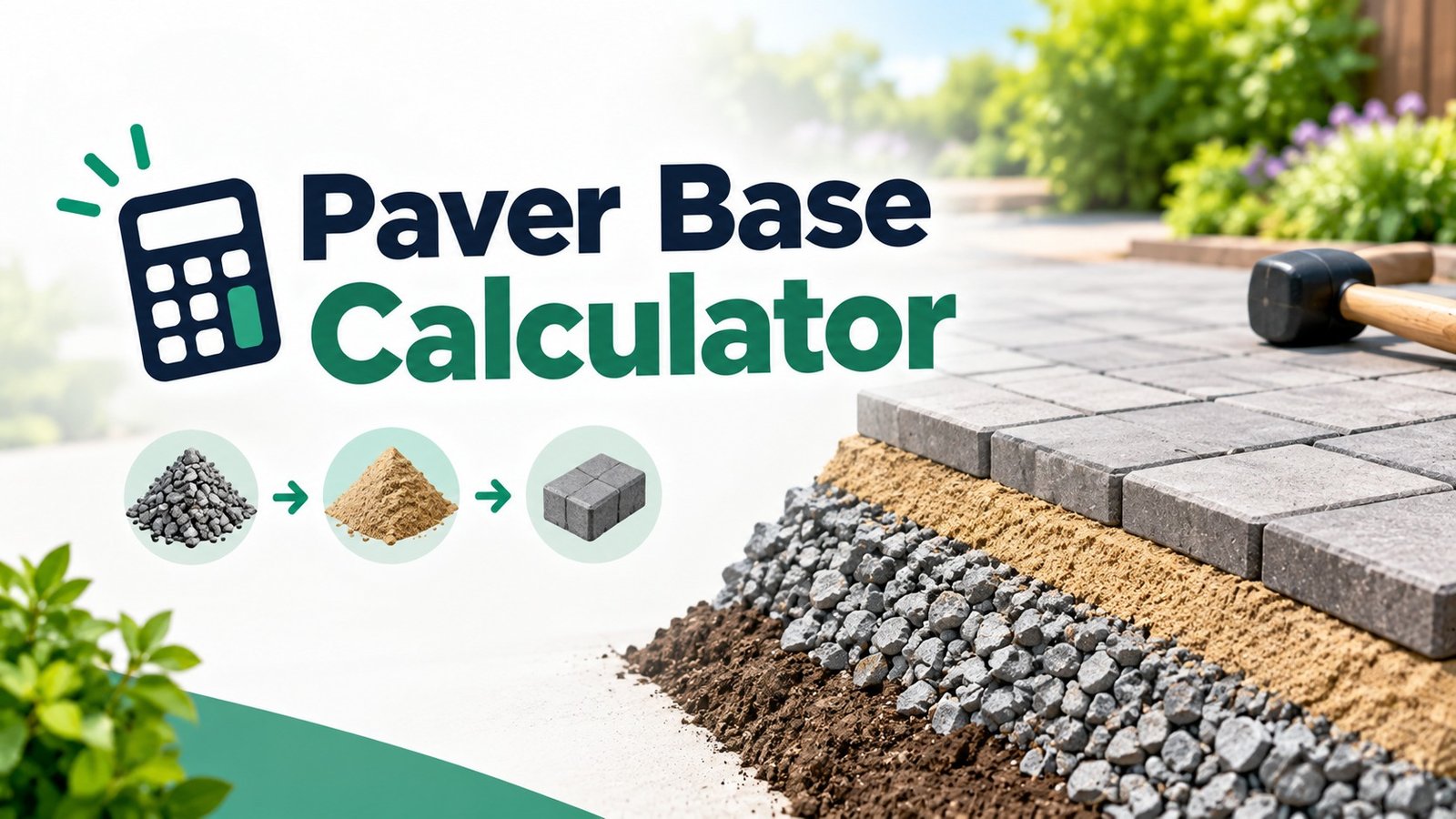
Paver Base Calculator
Find the base gravel, sand, pavers and cost for a patio, walkway or small driveway. Enter the size, pick the use and the paver, and see a layer diagram, a paver layout and charts. Every step of the math is shown.
Last updated: October 15, 2026. Written and maintained by Shivam.
On this page
Calculate paver materials
Optional: base, sand, pallets and prices
Results are estimates for planning. Base depth, paver coverage and material weights vary, so confirm with the paver maker and your supplier, and follow local rules. Read our Disclaimer.
Quick answer: multiply the base area by the depth in feet, add about 20 percent for compaction, and divide by 27 for cubic yards. A 6 inch base on a 12 by 12 foot patio that extends 6 inches past each edge needs about 3.76 cubic yards, or 5.26 tons of crushed stone. Add about 1 inch of bedding sand under the pavers.
What this paver base calculator does
This paver base calculator works out everything under and between the pavers on a patio, walkway or small driveway: the crushed-stone base, the bedding sand, the pavers and the joint sand. It also estimates edge restraint and a materials and labor cost.
Enter the patio size, pick the use and the paver, and the calculator adds the things that are easy to forget. The base extends past the edges, crushed stone shrinks when it is compacted, pavers need a joint, and every pattern wastes some pavers in cuts. A cross-section drawing and a to-scale paver layout show what you are buying, and a second tab shows how many pavers cover a square foot for each common size. If you need the area first, use our square footage calculator. If you are pouring concrete instead, the concrete slab cost calculator prices that route.
How to use the paver calculator
- Enter the patio. Choose a rectangle, a circle or a known area, then type the size in feet or meters.
- Pick the use. Walkway, patio or driveway sets a typical base depth. You can type your own depth.
- Choose the paver. Pick a common size or enter a custom one, then set the thickness and the joint width.
- Set the pattern. The pattern sets the allowance for cut pavers.
- Add the optional details. Add square feet per pallet and local prices to get pallets and a cost.
Tap the small i beside any field for what to measure. The results update as you type.
What goes under a paver patio
A paver patio is a stack of layers, and each one needs its own quantity. From the bottom up:
- Compacted soil. The ground is dug out to the full depth, leveled and compacted.
- Crushed-stone base. This carries the load and drains water. It is commonly 4 to 6 inches for patios and walkways and 8 to 12 inches for driveways, compacted in layers of about 4 inches.
- Bedding sand. A layer about 1 inch deep that is screeded flat so the pavers sit level.
- Pavers. Pavers about 2 3/8 inches thick suit foot traffic, and 3 1/8 inch pavers are common where vehicles drive.
- Edge restraint and joint sand. Edging stops the pavers spreading, and sand swept into the joints locks them together.
The patio should also slope slightly away from buildings so water drains. A common guide is about 1/4 inch per foot.
How much paver base do I need?
To calculate paver base, find the area the base covers, multiply by the depth, and add for compaction. The base is bigger than the patio because it should extend past the edges, commonly by at least 6 inches, so the edge restraint sits on solid stone. Crushed stone also shrinks when it is compacted, so plan on about 20 percent more than the finished volume.
Formula: Base (cu ft) = Base area × Depth ÷ 12 × 1.20. Divide by 27 for cubic yards, then multiply by about 1.4 tons per cubic yard for the weight your quarry will sell.
This table shows the base for 100 square feet, with no extension past the edges, 20 percent compaction and 1.4 tons per cubic yard. Use it to see how depth drives the load, and the calculator for your own patio.
| Base depth | Cubic yards | Tons |
|---|---|---|
| 4 in | 1.48 cu yd | 2.07 tons |
| 6 in | 2.22 cu yd | 3.11 tons |
| 8 in | 2.96 cu yd | 4.15 tons |
| 10 in | 3.70 cu yd | 5.19 tons |
| 12 in | 4.44 cu yd | 6.22 tons |
Each extra inch of base adds the same amount, so going from 4 inches to 6 inches adds half again as much stone. The base depth chart in the calculator shows this for your patio and works as a quick paver base depth calculator. A quarry can confirm the weight per cubic yard of the stone you choose, so edit the figure if yours differs.
How much paver sand do I need?
There are two sands, and this paver sand calculator sizes both. Bedding sand goes under the pavers, usually about 1 inch deep. Joint sand is swept into the gaps between pavers afterwards. To calculate paver sand for the bedding layer, multiply the patio area by the depth in feet and add 10 percent. For 100 square feet at 1 inch, that is about 0.34 cubic yard, or 0.48 tons.
Joint sand depends on the joint width and the paver thickness. The calculator finds the share of the area taken by joints and fills them to the paver thickness, then converts to 50 pound bags. Tight joints between large pavers take very little, and wide joints between small pavers take more.
How many pavers do I need?
To work out how many pavers you need, divide the patio area by the area of one paver plus its joint, then add an allowance for cuts. The joint is added to each paver so the count matches the real spacing.
Formula: Pavers = Patio area ÷ ((Length + Joint) × (Width + Joint) ÷ 144) × (1 + Allowance).
Here is how many pavers cover a square foot for common sizes with a 1/8 inch joint, before any allowance.
| Paver size | Face area | Pavers per sq ft | Pavers per 100 sq ft |
|---|---|---|---|
| 4 × 8 in | 0.222 sq ft | 4.30 | 430 |
| 6 × 6 in | 0.250 sq ft | 3.84 | 384 |
| 6 × 9 in | 0.375 sq ft | 2.58 | 258 |
| 12 × 12 in | 1.000 sq ft | 0.98 | 98 |
| 16 × 16 in | 1.778 sq ft | 0.55 | 55 |
| 12 × 24 in | 2.000 sq ft | 0.49 | 49 |
| 24 × 24 in | 4.000 sq ft | 0.25 | 25 |
How many 12×12 pavers for a 10×10 patio?
A 10 by 10 foot patio is 100 square feet. A 12 inch paver with a 1/8 inch joint covers about 1.021 square feet, so the area works out to 97.9 pavers, and with a 5 percent allowance you order 103. Many people simply say 100, which is a fair rule of thumb for square pavers with tight joints.
Because the tool takes a rectangle, a circle or a known area, it also works as a general paving calculator for walkways and pads.
How many pavers are in a pallet?
Pavers are usually sold by the pallet, and a pallet is described by the area it covers rather than a paver count. How many square feet are in a pallet of pavers depends on the size and thickness of the paver, and it often falls somewhere around 100 to 150 square feet, but it varies. Ask your supplier for the coverage of the exact paver you want.
Type that number into the optional field and the calculator divides your area, with the allowance, by it. For example, if a pallet covers 120 square feet, a 144 square foot patio with 5 percent extra needs 151.2 square feet, which is 1.26 pallets, so 2. The number is only an example, so use your supplier’s figure.
Worked example
Take a 12 by 12 foot patio built from 6 by 9 inch pavers, 2 3/8 inches thick, with a 1/8 inch joint, a running bond and a 5 percent allowance. The base is 6 inches deep and extends 6 inches past each edge, with 1 inch of bedding sand. These are the calculator defaults, so you can confirm the numbers.
- Patio area: 12 × 12 = 144 square feet.
- One paver with its joint: 9.125 × 6.125 ÷ 144 = 0.3881 square feet, or 2.58 pavers per square foot.
- Pavers: 144 ÷ 0.3881 = 371.0, and with 5 percent extra 389.6, rounded up to 390 pavers.
- Base area: 13 × 13 = 169 square feet, because the base extends 6 inches on every side.
- Base volume: 169 × 6 ÷ 12 × 1.20 = 101.4 cubic feet, which is 3.76 cubic yards, or about 5.26 tons.
- Bedding sand: 144 × 1 ÷ 12 × 1.10 = 13.2 cubic feet, or 0.49 cubic yards, about 0.68 tons.
- Joint sand: about 110 pounds, so 3 bags of 50 pounds.
- Edge restraint: the 48 foot perimeter.
Paver patio cost
A paver patio cost has five parts: the pavers, the base stone, the sand, the edge restraint and labor. Pavers and labor are usually the biggest lines, and the base is the quantity people most often underestimate. Prices depend on the paver, your region and how far materials travel, so enter local quotes in the optional section rather than relying on an average. If you do the work yourself, leave labor blank.
The calculator multiplies each quantity by the price you enter and totals them. As an example only, for the patio above with made-up prices of $4.00 per square foot of pavers, $35 per ton for base and sand, $30 per bag of joint sand and $2.50 per foot of edging, the materials come to $604.80 for pavers, $184.02 for base, $23.96 for bedding sand, $90.00 for joint sand and $120.00 for edging, or $1,022.78 in total. That works out to a paver cost per sq ft of $7.10 for the whole patio in materials, before labor. Those prices are invented to show the math, so use your own quotes. To see an installed price per square foot, add your installer’s labor rate and the total shows the cost to install pavers on your patio.
Planning tips and safety
- Call before you dig. In the United States, dial 811 or visit Call 811 a few days ahead so buried utilities are marked.
- Compact in layers. Spread the base in layers of about 4 inches and compact each one with a plate compactor. A thick single layer will settle later.
- Keep sand for leveling only. Bedding sand should be a uniform layer. Fill low spots with base stone, not extra sand.
- Mix your pallets. Pavers vary slightly in color between batches. Pull from several pallets as you lay so the patio blends evenly.
- Plan the cuts. A paver size that divides your patio size evenly needs fewer cuts, and fewer cuts mean a lower allowance.
- Mind the dust. Cutting pavers releases silica dust. Wet-cut or use dust control and a respirator. See the OSHA silica guidance.
- Use industry guidance. The Interlocking Concrete Pavement Institute publishes installation guidance for concrete pavers.
Check the paver maker’s instructions and your local rules before you order. If a garden wall edges the patio, our concrete block calculator counts the blocks. For soil to regrade around the finished patio, use the topsoil calculator, and browse all our concrete calculators for related tools.
Paver calculator FAQs
How do I convert tons of paver base to cubic yards?
Divide the tons by the weight of one cubic yard of your stone, which is about 1.4 tons for crushed stone. The default patio needs 5.26 tons, which is 3.76 cubic yards. Your quarry can give the exact figure.
Do I still need sand if I have a base?
Yes. The base carries the load, and a thin layer of bedding sand, about 1 inch, lets you set the pavers level. Do not use sand to fill low spots in the base.
Is paver base the same as gravel?
Paver base is usually a crushed stone that includes fine particles so it compacts tightly. Rounded pea gravel does not lock together well. Ask your quarry which stone they recommend for pavers.
Can I lay pavers directly on soil or sand?
It is not recommended. Without a compacted base, pavers settle, shift and hold water. Even a light-duty walkway benefits from a few inches of compacted stone.
How much extra should I order for cuts?
About 5 percent for stack or running bond, 10 percent for herringbone or basket weave, and 15 percent for diagonal or curved layouts. The calculator sets these for you, and you can type your own.
Is it cheaper to install pavers myself?
You save the labor, which is a large part of the cost, but you need tools such as a plate compactor and a wet saw, and a few days of work. Leave the labor price blank to see the materials-only cost.
Do I need polymeric sand?
Not always. Polymeric sand has a binder that hardens when it is wetted, which helps resist weeds and washout. Plain joint sand also works, and the volume is the same. Follow the paver maker and the sand instructions.
Can I use this for a driveway?
You can use it to estimate quantities. A driveway needs a deeper base and thicker pavers, and the design depends on soil and traffic, so treat the result as a material estimate and check with the paver manufacturer.
Read our Disclaimer, or contact us if you spot a mistake.