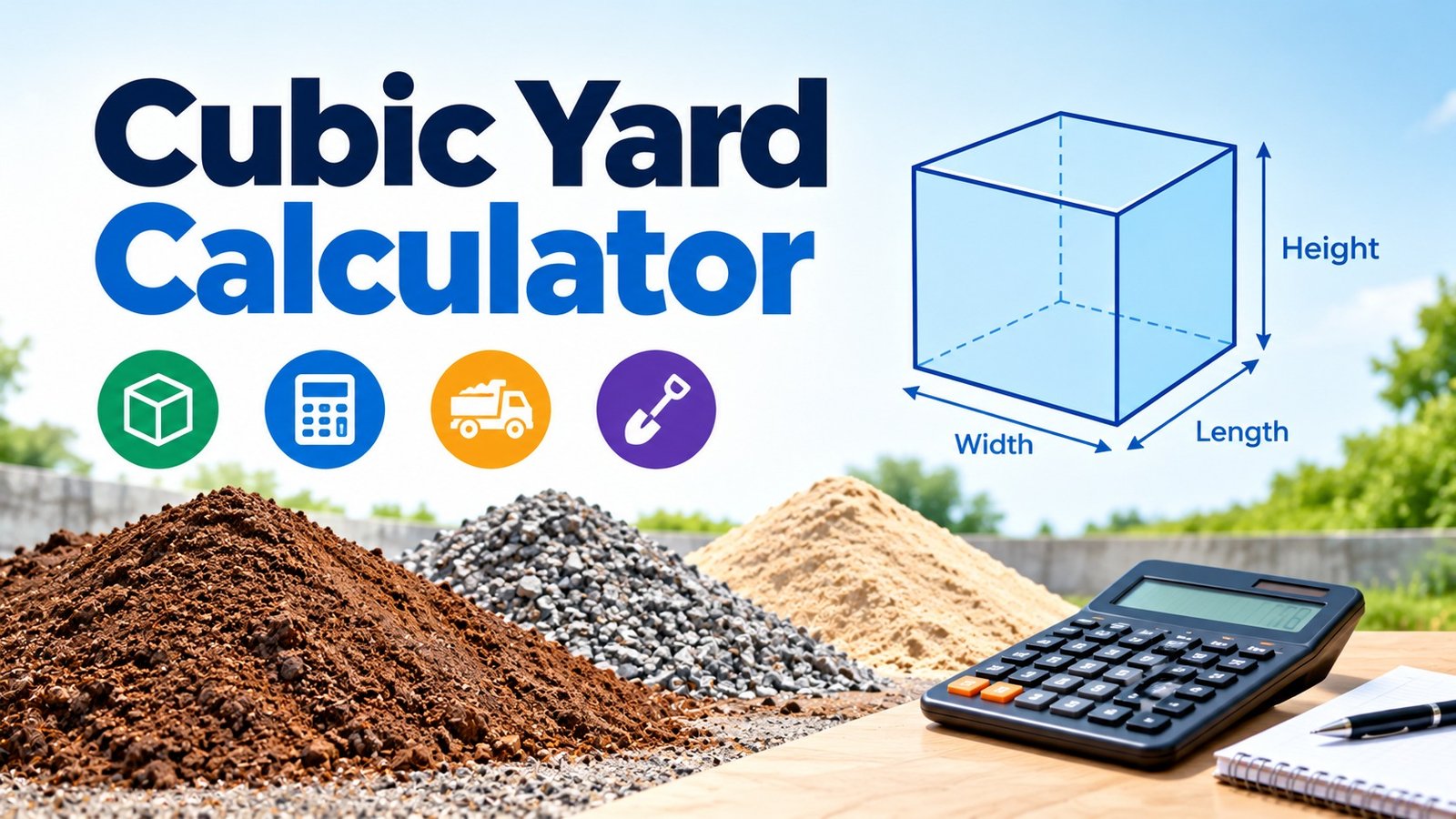
Cubic Yard Calculator
This cubic yard calculator turns a length, width and depth, a circle, an area, a known volume or a weight into cubic yards. It also shows cubic feet and cubic metres, the amount to order with extra, the weight in tons, bags, truck loads and the cost. Use it to calculate cubic yards of dirt, soil, gravel, sand, mulch or concrete. Tap the i button beside any field for an explanation.
Quick answer: cubic yards = length (ft) × width (ft) × depth (ft) ÷ 27. A 20 × 10 ft space filled 4 inches deep is 66.7 cubic feet, which is 2.47 cubic yards.
Cubic yard calculator: enter your space
Example values are loaded so you can see a result straight away. Change any field and the numbers update.
1. Choose your units
i
i
2. What do you know?
i
i
i
i
i
i
i
i
i
i
3. Material and extra
i
i
i
i
4. Price, bags and delivery
i
i
i
i
Volume at different depths
Weight by material
Estimates for planning only. Weights, prices and truck capacity are examples you can edit, not quotes. Measure the space yourself and confirm amounts and minimums with your supplier. See our Disclaimer.
How the cubic yard calculator works
Soil, gravel, mulch and concrete are almost always sold by the cubic yard, but most of us measure a space in feet and inches. The gap between the two is where orders go wrong. Order too little and you wait for a second delivery. Order too much and you are left with a pile you did not plan for.
This cubic yard calculator closes that gap. Tell it what you know: the length, width and depth of a space, the diameter of a round bed, an area, a volume in another unit, or a weight. It converts that to cubic yards, then shows the same amount in cubic feet and cubic metres. It adds your extra allowance, rounds the order up to the step your supplier uses, and estimates the weight, the bags, the truck loads and the cost.
How to calculate cubic yards
You can calculate cubic yards by hand in three steps, and the calculator follows exactly the same path:
- Measure in feet. Get the length and width in feet. Convert the depth from inches to feet by dividing by 12.
- Multiply. Length × width × depth gives cubic feet.
- Divide by 27. One cubic yard holds 27 cubic feet, so cubic feet ÷ 27 is cubic yards.
Worked example: a rectangle
A space 20 ft long and 10 ft wide, filled 4 inches deep, is 20 × 10 × (4 ÷ 12) = 66.7 cubic feet. Divide by 27 and you get 2.47 cubic yards. Add 5% for settling and spillage and the total is 2.59, which rounds up to 2.75 cubic yards when your supplier sells in quarter-yard steps.
Worked example: a round bed
For a circle, the area is π × radius squared. A bed 8 ft across has a 4 ft radius, so its area is π × 4 × 4 = 50.3 sq ft. Filled 6 inches deep, that is 25.1 cubic feet, or 0.93 cubic yards.
Cubic feet to cubic yards: the rule of 27
A yard is 3 feet. A cubic yard is a cube that is 3 feet in each direction, so it holds 3 × 3 × 3 = 27 cubic feet. That single number does every conversion on this page. To go from cubic feet to cubic yards, divide by 27. To go from cubic yards to cubic feet, multiply by 27.
| Cubic feet | Cubic yards | Cubic metres |
|---|---|---|
| 10 | 0.37 | 0.28 |
| 27 | 1.00 | 0.76 |
| 50 | 1.85 | 1.42 |
| 100 | 3.70 | 2.83 |
| 200 | 7.41 | 5.66 |
| 500 | 18.52 | 14.16 |
| 1,000 | 37.04 | 28.32 |
If you work in metric, the conversion is built on the exact definition of the yard, 0.9144 metres, which gives 0.7646 cubic metres per cubic yard. The volume option in the calculator accepts cubic feet, cubic inches, cubic metres, litres or cubic yards, so you can convert in any direction.
Square feet to cubic yards: add the depth
People often search for square feet to cubic yards as if it were a direct conversion. It is not. Square feet describe a surface and cubic yards describe a volume, so you need the depth to bridge them. Multiply the area by the depth in feet, then divide by 27.
A handy shortcut comes from that rule. One cubic yard covers 324 sq ft at a depth of 1 inch, because 27 cubic feet spread 1/12 of a foot deep covers 27 × 12 = 324 square feet. Halve it for 2 inches, and so on.
| Depth | Sq ft covered by 1 cubic yard | Cubic yards for 100 sq ft | Cubic yards for 500 sq ft |
|---|---|---|---|
| 1 in | 324 | 0.31 | 1.54 |
| 2 in | 162 | 0.62 | 3.09 |
| 3 in | 108 | 0.93 | 4.63 |
| 4 in | 81 | 1.23 | 6.17 |
| 6 in | 54 | 1.85 | 9.26 |
| 8 in | 40.5 | 2.47 | 12.35 |
| 12 in | 27 | 3.70 | 18.52 |
As an example, 500 sq ft at 3 inches deep is 125.0 cubic feet, or 4.63 cubic yards. If you do not know the area yet, the square footage calculator measures it for rooms and odd shapes, and the depth chart in the results shows how your volume changes if you go a little deeper or shallower.
Dirt calculator: cubic yards of soil, topsoil and fill
Whether you call it a dirt calculator or a soil calculator, the job is the same: area times depth, divided by 27. The depth is the part to think about. Fill for a low spot can be a foot deep, while a topdressing over an existing lawn is closer to an inch. The depth chart in the results helps you compare, because it shows your volume at depths from 1 inch to 12 inches.
For a raised bed, measure the inside length, width and height, and use the number of identical areas if you are building more than one. Soil settles after it is watered, so most people add a little extra. For lawns and garden beds in particular, the topsoil calculator adds guidance on depth for lawns and raised beds, and the gravel calculator does the same for stone.
Cubic yard calculator for concrete
Concrete is also ordered by the cubic yard, and the arithmetic is identical. A 10 × 10 ft slab that is 4 inches thick holds 10 × 10 × (4 ÷ 12) = 33.3 cubic feet, which is 1.23 cubic yards. Concrete cannot be topped up as easily as soil, so many people add extra for uneven ground and spillage. At 10% extra, this slab becomes 1.36 cubic yards.
Set the extra allowance in the calculator to match. For slabs, footings and bagged mix, the concrete yard calculator and the concrete bag calculator cover the details specific to concrete.
Cubic yards to tons calculator
Suppliers often charge by the ton, and trucks have weight limits, so converting cubic yards to tons matters. The method is simple: multiply the volume by the weight of one cubic yard of that material. The difficulty is that the weight changes with moisture and compaction. Wet soil is heavier than dry soil, and packed gravel is heavier than loose gravel.
These typical ranges come from published density charts. The calculator starts each material at a typical figure and lets you replace it.
| Material | Typical tons per cubic yard | Calculator uses (lb per cubic yard) |
|---|---|---|
| Soil or dirt (dry, loose) | 1.0 to 1.3 | 2,050 |
| Sand (dry) | 1.3 to 1.5 | 2,620 |
| Gravel or crushed stone | 1.4 to 1.7 | 2,835 |
| Concrete | 1.85 to 2.11 | 4,000 |
| Mulch | 0.2 to 0.4 | 600 |
For our 20 × 10 ft example, the 2.75 cubic yard order of soil weighs about 2.82 tons at the calculator’s starting figure. To go the other way, choose the weight option, enter the tons and pick the material, and the calculator divides the weight by the weight per cubic yard. The weight chart in the results shows how the same order would weigh in each material, which is a quick way to see why a cubic yard of mulch and a cubic yard of gravel are very different loads.
How big is a cubic yard?
A cubic yard is easier to picture when you see what it equals. It is a cube 3 feet on each side, or 27 one-cubic-foot bags. The table gives the common equivalents.
| A cubic yard equals | Amount |
|---|---|
| Cubic feet | 27 |
| Cubic inches | 46,656 |
| Cubic metres | 0.7646 |
| Litres | 764.6 |
| US gallons | 202 |
| Bags of 1 cubic foot | 27 |
| Bags of 0.5 cubic foot | 54 |
That bag count is why bagged products get expensive for large jobs. For larger jobs, bagged material gets hard to handle, so the calculator shows bags and bulk side by side for you to compare. It counts bags from your volume with the extra allowance, so 70 one-cubic-foot bags would cover the example.
Rounding, bags and truck loads
An exact volume is only the starting point. Suppliers sell in steps, delivery trucks carry a fixed amount, and a pile that is slightly short is more annoying than one that is slightly long. The calculator therefore shows several figures side by side:
- Exact volume is the plain geometry, with no allowance.
- Order amount adds your extra percentage and rounds up to the step you choose.
- Extra included is the difference between the two, so you can see how much of the order is a cushion.
- Truck loads divide the order by the truck capacity you enter. The capacity is a placeholder, so ask your supplier for the real number.
- Cost multiplies the order by the price and adds any delivery fee.
Prices vary by region, material and supplier, so the example price is only a placeholder. Replace it with a quote.
Common mistakes when you calculate cubic yards
- Leaving the depth in inches. Divide inches by 12 before multiplying, or enter the depth in the inches field and let the calculator do it.
- Mixing up yards and cubic yards. A yard is 3 feet, but a cubic yard is 27 cubic feet, not 3.
- Forgetting settling. Soil and mulch compress, so an exact order often falls a little short.
- Assuming one weight fits all. The same cubic yard can weigh very differently when it is wet or compacted.
- Measuring only the top. For a hole or a bed, measure the depth in the deepest part, or average it for uneven ground.
This page is a planning tool, and suppliers have their own minimums and units. Confirm your order with them before you buy.
Cubic yard calculator FAQ
How many cubic feet are in a cubic yard?
There are 27. A cubic yard is a cube that is 3 feet long, 3 feet wide and 3 feet high, and 3 × 3 × 3 = 27 cubic feet. To convert cubic feet to cubic yards, divide by 27.
Why can I not convert square feet straight to cubic yards?
Square feet measure a flat area, while cubic yards measure a volume. You need a third measurement, the depth. Multiply the area by the depth in feet and divide the result by 27, which the calculator does when you choose the area option.
How many cubic yards do I need for a 10 × 10 ft area that is 4 inches deep?
The volume is 10 × 10 × (4 ÷ 12) = 33.3 cubic feet, which is 1.23 cubic yards. With 10% extra, order about 1.36 cubic yards.
How many cubic yards of dirt do I need for a raised bed?
Multiply the length, width and height of the bed in feet, then divide by 27. A bed that is 8 ft long, 4 ft wide and 1 ft deep holds 32 cubic feet, which is 1.19 cubic yards.
How much does a cubic yard of dirt weigh?
Charts typically show about 1 to 1.3 tons for dry soil, about 1.3 to 1.5 for compacted soil and 1.5 to 1.7 for wet soil. Moisture and compaction change the weight a lot, so use your supplier’s figure when you have one.
How many cubic yards of concrete do I need for a slab?
Multiply the length, width and thickness in feet and divide by 27. A 10 × 10 ft slab that is 4 inches thick needs 1.23 cubic yards, and a little more once you add an allowance for waste and uneven ground.
How many bags make a cubic yard?
It depends on the bag size. A cubic yard is 27 bags of 1 cubic foot, 54 bags of 0.5 cubic foot, or 13.5 bags of 2 cubic feet, which you would round up to 14.
How many feet are in a yard?
There are 3 feet in a yard, which is a length. A cubic yard is a volume, so it is 3 feet in each of three directions. People often mix the two, which is why a yard of soil is not 3 cubic feet.
How much extra should I add when I order?
A small allowance covers settling, spillage and uneven ground. Many people add around 5 to 10 percent, and the calculator lets you choose the figure. It then rounds up to the step you pick, because suppliers rarely sell an exact amount.
How many cubic yards fit in one truck load?
It varies by truck, so ask your supplier. Enter the truck capacity in the calculator and it will show how many loads your order takes.
How many tons is 5 cubic yards of gravel?
Multiply by the weight per cubic yard. At the calculator’s figure of 2,835 lb per cubic yard, 5 cubic yards weigh about 7.1 tons. Typical charts give 1.4 to 1.7 tons per cubic yard, so the real weight may be 7 to 8.5 tons.
Sources and further reading
The volume maths is plain geometry. The typical material weights come from published density charts, and the conversions follow the standard definitions of the yard and the cubic foot.
- Inch Calculator, cubic yards to tons (typical tons per cubic yard for soil, sand, gravel, concrete and mulch)
- Engineering ToolBox, dirt and mud densities (densities of dry and wet soil, sand and gravel)
- NIST Special Publication 811 (guide to the SI, with unit conversion factors)
Material weights vary, so use your supplier’s figure when they give you one.
Plan the rest of the project
Filling a garden? Use the topsoil calculator for beds and lawns and the gravel calculator for paths and drives. For a patio, the paver base calculator sizes the base layer. Pouring concrete? Try the concrete slab cost calculator, or browse the concrete calculators hub for more.