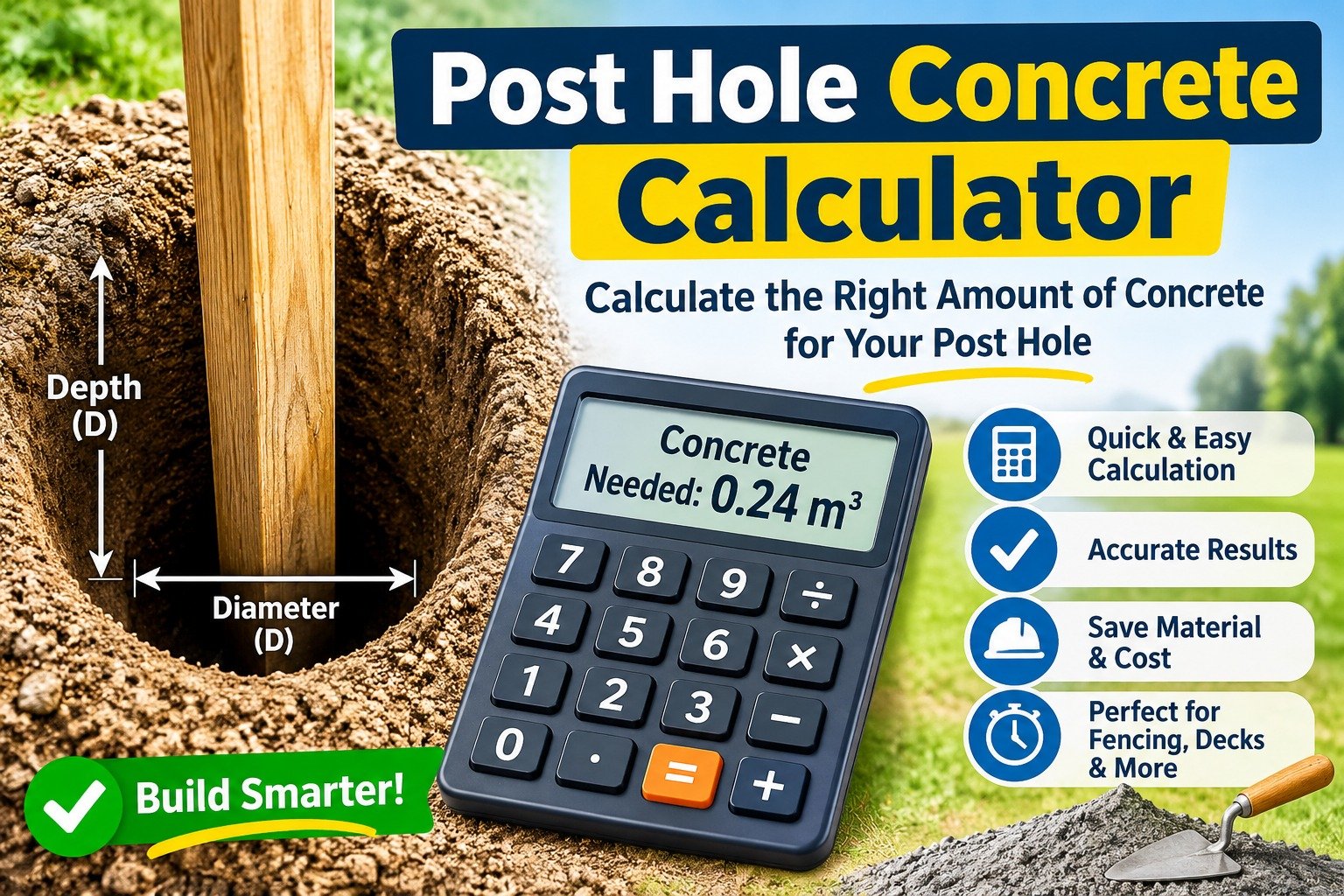
Post Hole Concrete Calculator
This post hole concrete calculator works out how many bags of concrete you need to set fence posts, deck posts or any other post. It takes the post size, the hole, the depth, the gravel base and gate posts, then shows the bags, cubic feet and cost, and draws the post in its hole. Tap the i button beside any field for an explanation.
Quick answer: concrete per post = hole volume − post volume. A 4×4 post in a 12 in round hole with 24 in of concrete needs about 1.4 cubic feet, which is roughly 3.7 bags of 50 lb concrete. Buy for the whole job, then add 5 to 10%.
Post hole concrete calculator: bags, cubic feet and cost
Example values are loaded so you can see a result straight away. Change any field and the numbers, the drawing and the charts update.
1. Units and currency
i
i
2. Your post
i
i
i
i
i
i
i
3. Your hole
i
i
i
i
i
i
i
i
4. Buying (optional)
i
i
i
i
Your post in its hole
The drawing redraws as you change the numbers. The depth and width are drawn to scale for your first post, and the part of the post above ground is cut short to fit. The top view shows the ring of concrete around the post.
Checks against published guidance
Bags needed at different hole sizes
Bags needed by bag size
Estimates for planning only. Hole sizes, depths and bag yields come from published guides and vary with the post, the soil, the climate and the product, so follow your plans, your local code and the label on the bag. Prices are examples you can edit, not quotes. See our Disclaimer.
How this post hole concrete calculator works
Most people who search for a concrete post hole calculator want one number: how many bags to carry out of the store. The trouble is that the answer depends on four things at once, which are the size of the post, the width of the hole, the depth of the hole and the bag you buy. Change any one and the bag count moves, and a fence with a dozen posts multiplies every mistake by twelve.
This concrete calculator for post holes takes all four, adds the details that people forget, such as a gravel base, frost depth and heavier gate posts, and returns the bags, the cubic feet and the cost for the whole job. It draws your post in its hole from the side and from above, charts how much extra concrete a wider hole would cost, and shows the same job in 40, 50, 60 and 80 pound bags. Whether you call it a fence post concrete calculator, a way to calculate concrete post holes, a post hole concrete estimator or a post hole calculator for concrete, it does the same sum. Tap the i button beside any field for an explanation.
It works for fence posts, but it works just as well for deck posts, mailbox posts, sign posts and pergola posts. If you are pricing the whole fence, the fence cost calculator covers the panels and labor, and this page covers the concrete.
How to calculate concrete for post holes
If you want to calculate concrete for post holes by hand, or check the result, there are five steps. The calculator follows the same ones.
- Find the hole size. Guides say to dig a hole about three times the width of the post. A 4×4 gets a 12 inch hole, and a 6×6 gets an 18 inch hole.
- Find the burial depth. Bury about one third to one half of the above-ground height, and go below the frost line.
- Find the hole volume. For a round hole, π ÷ 4 × diameter² × concrete depth. For a square hole, width² × concrete depth.
- Subtract the post. The buried post takes up space, so the concrete you need is the hole volume minus the post volume.
- Convert to bags. Divide cubic feet by the yield of the bag, add 5 to 10 percent, multiply by the number of posts and round up.
Worked example. The default fence has 12 posts, 2 of them gate posts, each 6 feet above ground. Line posts are a 4×4 (3.5 inches across) in a 12 inch round hole. A line post is buried 24 inches, which is one third of its height, so the hole is 30 inches deep with a 6 inch gravel base. The concrete is 1.40 cubic feet per line post. The two gate posts are buried 36 inches and take 2.10 cubic feet each. In total that is 18.2 cubic feet, or 20.0 with 10 percent extra, which is 54 bags of 50 pound concrete, about 4.5 per post. At an example price of $6 a bag, the concrete costs $324.
How much concrete per fence post?
If you only want a quick figure for one post, the table below shows the concrete in a 4×4 and a 6×6, using the hole sizes above. The depth is the depth of the concrete, which is the burial depth because the gravel sits underneath. Bags are for 50 pound bags at 0.375 cubic feet each.
| Depth of concrete | 4×4 in a 12 in hole (cu ft) | 4×4 bags of 50 lb | 6×6 in an 18 in hole (cu ft) | 6×6 bags of 50 lb |
|---|---|---|---|---|
| 18 in | 1.05 | 2.8 | 2.34 | 6.2 |
| 24 in | 1.40 | 3.7 | 3.11 | 8.3 |
| 30 in | 1.75 | 4.7 | 3.89 | 10.4 |
| 36 in | 2.10 | 5.6 | 4.67 | 12.5 |
| 42 in | 2.45 | 6.5 | 5.45 | 14.5 |
So how many bags of concrete per fence post? For a 4×4 buried 24 inches it is about three and a half to four 50 pound bags, and for a 6×6 buried 36 inches it is about 12 or 13. The post count is what makes the total large. The numbers use the real size of a 4×4, which is 3.5 inches across. Bob Vila’s worked example treats a 4 inch post as round, in a 12 inch hole with 48 inches of concrete, and gets 2.79 cubic feet. This calculator gives 2.80 cubic feet for a 4×4 in the same hole, which is close because a 3.5 inch square post takes up almost the same room as a 4 inch round one.
If you are asking how much concrete per post for fence work with posts in a different size, use the calculator. It takes any post and hole size, and it keeps the gate posts separate, which is why a fence with a few gates needs more than the average suggests.
How deep to dig fence posts
The depth rule is the part that varies most between guides, and it also decides how much concrete you need, because depth multiplies everything. Angi says to bury a post one third to one half of its above-ground height, then add 3 to 6 inches for gravel. The deeper half applies to gate posts, heavy fences such as chain-link or wrought iron, clay or loam soil and windy sites. A one-third burial can work for light panel posts in firm soil such as sandy loam or gravel.
Here is that rule worked out for common fence heights. The hole depth includes the gravel, and gate posts use the half rule with a 6 inch gravel base.
| Fence height above ground | Line post hole depth (one third plus 3 in gravel, to one half plus 6 in) | Gate post hole depth (one half plus 6 in) |
|---|---|---|
| 3 ft | 15 to 24 in | 24 in |
| 4 ft | 19 to 30 in | 30 in |
| 5 ft | 23 to 36 in | 36 in |
| 6 ft | 27 to 42 in | 42 in |
| 7 ft | 31 to 48 in | 48 in |
| 8 ft | 35 to 54 in | 54 in |
This is the table the fence post depth calculator in the tool above uses. Pick the one-third rule for line posts, the one-half rule for heavier fences, or enter your own hole depth if your plans give one.
Frost depth
In cold climates the frost line can matter more than the fraction. Angi says to set posts below the frost line to prevent heave, and if local code gives no figure and your ground freezes, to go at least 24 inches deep. Bob Vila says the frost line averages about 3 feet down in most areas, but it varies a lot by region, so I do not give one number. Enter your local frost depth and the calculator uses whichever is deeper, the fraction rule or the frost depth. Your building department can tell you the figure for your area.
What size hole for a fence post?
Bob Vila, Angi, HelloGravel and Omni Calculator all give the same rule: make the hole about three times the width of the post. That leaves a ring of concrete about as thick as the post on each side. The calculator offers that as the default and fills in the hole for each preset post. The post sizes in the tool use the actual dimensions, so a 4×4 is 3.5 inches across and a 6×6 is 5.5 inches, but the three-times rule is applied to the nominal size, which is why a 4×4 gets a 12 inch hole.
A round hole, dug with an auger, is easier to keep at an even width. A square hole dug by hand works too, and the calculator handles both. A round hole has to be at least as wide as the diagonal of a square post, or the post will not fit, and the calculator checks that for you.
Digging wider than the rule costs money. The chart in the results shows the bags you would need at other hole widths for the same posts, so you can see what a few extra inches adds. A narrower hole saves concrete but leaves a thinner ring, and the guides give three times the width as the starting point.
Gravel under the post
Angi gives at least 3 inches of gravel in the bottom of the hole for drainage, which helps stop water collecting at the end of a wood post, Bob Vila gives 6 inches and HelloGravel gives 6 to 8 inches. The gravel also sets the bottom of the concrete, so it changes the hole depth but not the concrete volume. The calculator adds the gravel to the hole depth, subtracts it from the concrete depth, and shows the gravel volume so you know how much to buy. For a larger quantity, the gravel calculator converts it to cubic yards and tons.
If you want the concrete to finish below the surface so soil or turf can cover the top of the hole, enter that gap in the optional field. The calculator then shortens the concrete column by the same amount.
Fast-setting concrete mix for fence posts
Many people searching for a fast setting concrete mix for fence posts want to skip the mixing. Quikrete describes its Fast-Setting Concrete as designed to set hard in about 20 to 40 minutes, and says to pour the dry mix into the hole and soak it with water. Omni Calculator also notes that dry concrete can go in a post hole because the ground moisture helps it bind. That is the main reason it suits fences: there is no wheelbarrow, and the post can be braced while it sets.
If you are wondering how long does Quikrete take to set, 20 to 40 minutes is the figure the maker gives for its fast-setting product. Related questions are how long for Quikrete to dry and how to use Quikrete, and the label has the pouring details. Setting hard is not the same as full strength, so follow the label before you attach rails, hang panels or hang a gate. Standard concrete mix takes longer, and I do not give a time for it because I did not find a reliable source for one. Whatever you use, the bag gives the guidance for that product.
Any post hole concrete mix works with the calculator as long as you enter its yield. Bag sizes matter for the count. These are the yields the calculator starts from. Brands differ a little, so use the figure on your bag.
| Bag size | Yield per bag | Bags per cubic yard |
|---|---|---|
| 40 lb | 0.3 cu ft | about 90 |
| 50 lb | 0.375 cu ft | about 72 |
| 60 lb | 0.45 cu ft | about 60 |
| 80 lb | 0.6 cu ft | about 45 |
Concrete fence posts: set in concrete, or precast?
A search for concrete fence posts can mean two different things. Some people mean wood or metal posts set in concrete, which is what this page calculates. Others mean precast concrete posts, which are made of concrete and are sold as a finished post. If you are asking how much are concrete fence posts, those are a different product with their own sizes and prices, and I do not give a price for them because it varies by height, region and supplier, so ask for a quote. If you do use precast posts, you may still set them in concrete or compacted gravel, and this calculator will give you the concrete for the hole.
How to set fence posts
For anyone planning fence post installation, here is the order that the guides I read describe. Check the details against the bag label and your local rules.
- Mark and dig. Dig each hole to the width and depth you worked out, and a power auger keeps the width even.
- Add the gravel. Put the gravel in the bottom so the post has a firm bed and water can drain away from its end.
- Set the post. Stand the post on the gravel and use a level to make it plumb on two faces. Brace it so it stays still.
- Add the concrete. Pour the dry mix around the post, soak it with water if your product calls for that, and keep the post plumb.
- Wait. Leave it for the time on the label before you attach anything.
If you are installing fence posts for a deck or a pergola instead, the steps are the same, and the deck joist calculator and the deck board calculator cover the frame and the surface.
Why the guides disagree
If you compare calculators and guides you will find small differences. They are mostly in the rules, not the maths.
| Source | Hole width | Depth | Gravel |
|---|---|---|---|
| Bob Vila | About 3 times the post width | One third to one half of the height, and below the frost line | 6 inches |
| Angi | 3 times the post width | One third to one half of the above-ground height, deeper for gate posts | At least 3 inches |
| HelloGravel | About 3 times the post width | Below the frost line, no fixed fraction | 6 to 8 inches |
| Omni Calculator | 3 times the post width | At least one third of the post length | Not stated |
I did not pick a winner. The calculator lets you choose the depth rule, the gravel depth and the hole size, then shows how your choices compare with the published ones in the checks. When in doubt, the instructions for your fence, your soil and your local building code take priority.
Common mistakes when buying concrete for posts
- Counting the whole hole. The buried post takes up space. Subtract it, or you will buy too much.
- Forgetting the gravel. The gravel is part of the hole depth, not extra concrete.
- Using one depth for every post. Gate posts carry more load, so Angi sets them deeper than line posts.
- Digging the hole too wide. Every extra inch of width is concrete you pay for.
- Ignoring frost. A post set above the frost line can be pushed up in winter.
- Rounding per post. Buy bags for the whole job, then round up once, as the calculator does.
- Trusting the yield on a different brand. Check the bag you actually buy.
Post hole concrete calculator FAQ
How much concrete do I need for one post hole?
Subtract the volume of the buried post from the volume of the hole, down to the top of the gravel. A 4×4 in a 12 inch round hole with 24 inches of concrete takes about 1.4 cubic feet.
How many 50 lb bags of concrete for a 4×4 post?
About four for a post buried 24 inches, with the allowance included. The table in the article lists other depths, and the calculator works out the total for every post.
How many bags of concrete for a 6×6 post?
A 6×6 needs a wider hole, so it takes far more than a 4×4: around eight to nine 50 lb bags at 24 inches and about 13 to 14 at 36 inches.
Do gate posts need more concrete than line posts?
Yes, because they are set deeper. Angi sets gate posts at half the above-ground height, and the calculator treats them separately so the total is not understated.
Do I need gravel at the bottom of the hole?
The guides I read all give a gravel base. It lets water drain away from the end of the post, and it sits under the concrete, so it adds to the hole depth and not to the concrete volume.
Can I pour dry concrete into a post hole?
Quikrete says to pour its Fast-Setting Concrete in dry and then soak it with water, and Omni Calculator notes ground moisture helps dry concrete bind. Follow the directions on your product.
How long does fast-setting concrete take to set?
The maker quotes a range of 20 to 40 minutes to set hard, but that is not full strength. Check the label before you attach rails or hang a gate.
Do I round bags up for each post?
No. Add the concrete for all the posts, then round up once. Rounding each post separately overstates the total.
Is an 80 lb bag cheaper than 50 lb bags?
It depends on the price. Divide each bag price by its yield in cubic feet and compare. The bag chart in the results shows how many bags of each size the job needs.
Does this work for deck, mailbox or sign posts?
Yes. Enter the post size, the hole and the depth you plan to use. Deck footings and other structural posts may have their own code requirements, so check those first.
Sources and further reading
The volume maths is geometry. The hole size, depth and gravel rules and the bag yields come from the published guides below, which I read when writing this page. Where they differ from your plans or your bag label, follow those.
- Bob Vila, how much concrete per fence post (hole diameter, depth, gravel base and bag yields)
- Angi, how deep should a fence post be (depth by fence height, gate posts, frost line and gravel)
- HelloGravel, gravel for fence post holes (hole width and gravel base)
- Omni Calculator, post hole concrete (volume formula and the depth rule of thumb)
- Quikrete, Fast-Setting Concrete Mix (set time and the dry-pour method)
Products, prices and local rules vary, so check them with your supplier or building department.
Plan the rest of the project
If the concrete is for a fence, the fence cost calculator estimates the rest of the cost. For other concrete jobs, the concrete bag calculator, the concrete yard calculator and the concrete slab cost calculator cover slabs and footings, and the cubic yard calculator converts any volume you work out by hand. The concrete calculators hub lists them all, and the landscaping calculators cover gravel, soil and the garden around the fence.